
The Problem With Proliferation: Cruise Missile Edition
Published By Steeljawscribe On Wednesday, March 24th 2010. Under Missile Defense Tags: cruise missiles, proliferation
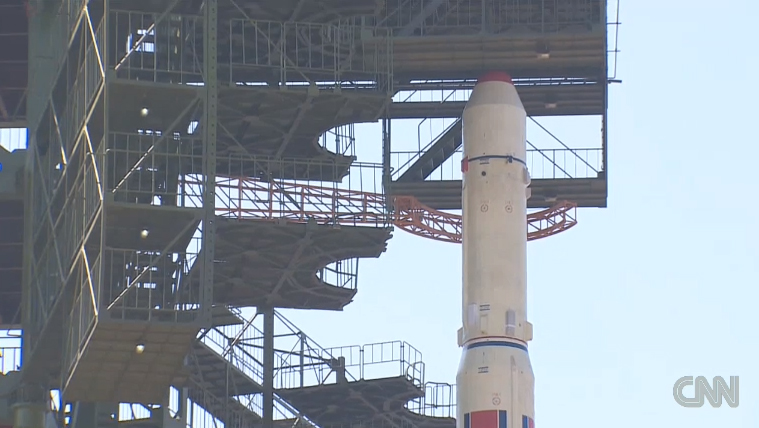
March 2011. The still of the pre-dawn darkness is only slightly disturbed by the passage of a container ship. Like the many thousands of others like her plying the ocean's ways, this one's cargo is neatly stacked on the deck -- ISO shipping containers in a multitude of colors and shippers markings. As the fog bank thickens, a radar scope is closely scrutinized on the bridge. Out here, off the shipping lanes no other merchant traffic is expected and, it would appear, neither were there any signs of fishing craft or more troubling, naval or coast guard ships. Earlier in the night a code had been passed via an internet podcast and confirmed via a secure webpage. Soon, very soon, part of the ship's cargo would complete the long journey begun in Sverdlovsk.
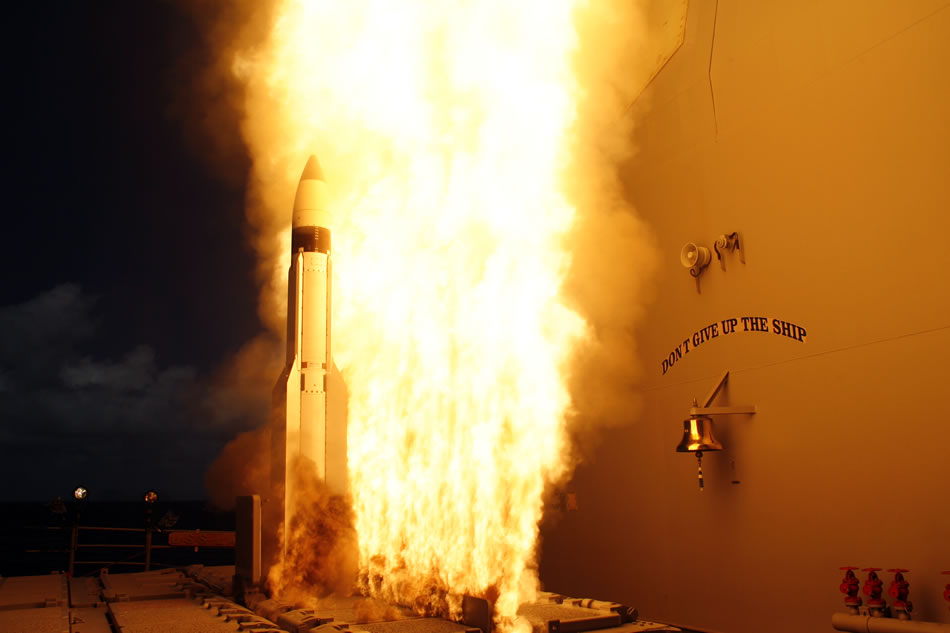
Up forward, locks are removed on two of the containers and a pair of shadowy figures enter each container. A series of muffled noises from the interior of the boxes is rapidly followed by their tops falling to one side and a brace of four tubes quickly rise to the vertical. A minute or two passes and the quiet is shattered by a series of explosions. From each tube a long, slender figure emerges atop a cloud of gases. Bright flames suddenly appear and the forms race off to the far horizon, away from the sun, still hours away from rising.
NAVSTA Norfolk has been home to US naval aviation ever since Eugene Ely first flew his fragile, kite-like ... Continue Reading
Aegis BMD: “Build a Little, Test a Little, Learn a Lot”
Published By Steeljawscribe On Tuesday, March 16th 2010. Under Missile Defense Tags: Aegis BMD, Missile Defense
Rear Admiral Meyer's philosophy of "Build a Little, Test a Little, Learn a Lot" drove the testing and milestones of the Aegis system. Having witnessed problems with existing missile systems related to a lack of testing, tests that incorporated too many objectives, and failed system integration efforts requiring massive "get well" programs, he drove the project to conduct numerous tests in development and in delivery of production gear prior to ship installation.
That philosophy carried over into the sea-based ballistic missile defense (BMD) program, using the Aegis weapons system at its core. The following are scenes from the development of Aegis BMD -- from the designing board to sea. A clear example of the results of following that philosophy may be seen in the sequence of test shots over the final two minutes of the film -- the early intercepts aimed for the center of mass of the target. As the tests progressed, watch how the aim point is walked forward towards the harder to hit but more important (simulated) warhead section of the target:
... Continue Reading
Wednesday’s Roll-up of Missile Defense News
Published By Steeljawscribe On Wednesday, March 10th 2010. Under Missile Defense Tags: Europe, Missile Defense, Russia
Two items of note for today's summary -- France may be seriously studying missile defense and Russia's at it again (re. European Phase Adaptive Approach - PAA).
Parlez-vous la Défense de Missile Balistique ?
A recent 65-page study on BMD, written by three members of Parliament at a think tank linked to the National Assembly ("Defense et Strategie") argues for France committing to building, or at least contributing to a BMD system to counter the growing threat from nations hostile to Europe (in general) and France (in particular). The authors, members of leading centrist parties, assert that the threat will grow over the next 15 years, especially from the likes of Iran, and (and this is a new argument) that a BMD is necessary to strengthen France's nuclear deterrent. In doing so, they also acknowledge that the political will to move forward is lacking in France and Europe (surprise!) and is an attitudede that they seek to change.
It is also perhaps worth noting that it was the Obama Administration's decision to press with the PAA over the former GBI-centric system the Bush Administration had planned that pushed the authors into the study. The reason? Their view that an American-led system and architecture establishes American industry as a threat, or 'double risk' for Europe -- double since the Europeans and NATO have yet to devise a comprehensive BMD policy in line with 21st Century threats and if one country equips itself with an American C2 system, it must, perforce, ... Continue Reading
Airborne Laser Testbed Successful in Lethal Intercept Experiment
Published By Steeljawscribe On Friday, February 12th 2010. Under Missile Defense Tags: ALTB, ballistic missiles, lasers, Missile Defense
From an MDA press release earlier today:
The Missile Defense Agency demonstrated the potential use of directed energy to defend against ballistic missiles when the Airborne Laser Testbed (ALTB) successfully destroyed a boosting ballistic missile. The experiment, conducted at Point Mugu Naval Air Warfare Center-Weapons Division Sea Range off the central California coast, serves as a proof-of-concept demonstration for directed energy technology. The ALTB is a pathfinder for the nation’s directed energy program and its potential application for missile defense technology.
At 8:44 p.m. (PST), February 11, 2010, a short-range threat-representative ballistic missile was launched from an at-sea mobile launch platform. Within seconds, the ALTB used onboard sensors to detect the boosting missile
Target launch from Mobile Launch Platform (MLP) for another test (Aegis BMD)
and used a low-energy laser to track the target. The ALTB then fired a second low-energy laser to measure and compensate for atmospheric disturbance. Finally, the ALTB fired its megawatt-class High Energy Laser, heating the boosting ballistic missile to critical structural failure. The entire engagement occurred within two minutes of the target missile launch, while its rocket motors were still thrusting.
This was the first directed energy lethal intercept demonstration against a liquid-fuel boosting ballistic missile target from an airborne platform. The revolutionary use of directed energy is very attractive for missile defense, with the potential to attack multiple targets at the speed of light, at a range of hundreds of kilometers, and at a low cost per intercept attempt compared to current technologies.
Less than one hour ... Continue Reading
Iran Announces New Space Launch Vehicle (SLV)
Published By Steeljawscribe On Thursday, February 4th 2010. Under Missile Defense Tags: ICBM, Iran, missiles, SLV
We are about one-third of the way through Iran’s annual “Ten Days of Dawn” observation which celebrates the victory of the Islamic revolution in Iran and the return of the Ayatollah Khomeini in 1979. The occasion serves as a platform for Iran to boast about progress under the Islamic Republic and demonstrate military, scientific and technical prowess. This, despite the West’s attempts to limit technology transfer in key areas, such as missile technology.
Day 3 of the celebration is set-aside as “Space Day” and yesterday, Iran’s President Ahmedenejad had three items of note/accomplishment to announce that:
Iran had launched a payload of animal specimens (a mouse, turtles and worms) into space and recovered them on a new research rocket named Kavoshgar-3 (Explorer-3);
Three new satellites were unveiled: the Tolou (Sunrise), the Mesbah 2 (Lantern 2), and the Navid (Promising Sign) and
A new space launch vehicle, Simorgh-3, which will serve as the launch vehicle for those satellites.
Simorgh SLV
Of these announcements, the last is the most interesting and perhaps, troubling. With the ability to loft 220 lbs into a 310 mile earth orbit (if it indeed works), that would move Iran into a new capability category with a nascent ICBM. The implications for the US and allies would be the impact on the European PAA and near term planning for the global BMDS, all of which (along with the BMDR) were predicated on a slower timeline for Iran to develop an ICBM capability, 2015 or ‘mid-decade.’ Tied with Iran’s continued intransigence on the nuclear front ... Continue Reading
BMDR Release and BMD Deployments to the Gulf
Published By Steeljawscribe On Tuesday, February 2nd 2010. Under Missile Defense Tags: Aegis BMD, BMDR, Iran, Missile Defense
Gulf BMD Deployments
Lots in the news today - let's start in the Gulf:
US officials have let it be known that it now has Patriot batteries in four Gulf states - Kuwait, Bahrain, the United Arab Emirates and Qatar. US anti-missile ships are also being stationed in the Gulf. All this comes as the impasse over Iran's nuclear activities continues and amid efforts by the US and other Western countries to increase sanctions on Iran. (BBC)
The outreached hand has obviously been slapped away once too often. Iran's continued intransigence on the nuclear issue combined with its growing inventory of ballistic missiles poses an implicit threat to the region. PAC-3 battery's deployed to the four GCC states provide a tangible, visible presence on the ground with regional friends and partners. BMD configured cruisers and destroyers, armed with SM-3s extend that reassurance with a measure of deterrence for the region with their ability to intercept longer range MRBMs in the Iranian inventory.
All of this falls into two of the four priority objectives outlined in the 2010 QDR, released today:
Prevail in Today's Conflicts
Prevent and Deter Conflict
Prepare to defeat adversaries and succeed in a wide range of contingencies
Preserve and enhance the All-Volunteer Force
Still, there are some who think that such a response will only strengthen the hand of extremists in Iran, emboldening them to crack down even harder on dissidents in general and the Green revolution in particular. The line of thought is that the hardliners believe that the absence of a viable ... Continue Reading
Chinese Announce Successful Missile Intercept Test
Published By Steeljawscribe On Tuesday, January 12th 2010. Under Missile Defense Tags: ASAT, BMD, China
From China today comes news today of a successful missile intercept test:
"BEIJING (AP) -- China announced that its military intercepted a missile in mid-flight Monday in a test of new technology that comes amid heightened tensions over Taiwan and increased willingness by the Asian giant to show off its advanced military capabilities. The official Xinhua News Agency reported late Monday that ''ground-based midcourse missile interception technology'' was tested within Chinese territory. ''The test has achieved the expected objective,'' the three-sentence report said. ''The test is defensive in nature and is not targeted at any country.'' Monday's report follows repeated complaints in recent days by Beijing over the sale by the U.S. of weaponry to Taiwan, including PAC-3 air defense missiles. These sales are driven by threats from China to use force to bring the island under its control, backed up by an estimated 1,300 Chinese ballistic missiles positioned along the Taiwan Strait."
Of course China doesn't do anything without some express purpose, and to that end we would note that today is the 3rd anniversary of the infamous ASAT test, conducted on 11 January 2007. Infamous, because of the on-orbit debris field it generated and near universal condemnation it engendered. So find ourselves three years later and coincident with that date and the announcement by the US of plans to go ahead with the sale of PAC-3 batteries to Taiwan as a (small) partial counter to the hundreds of SRBMs China has deployed.
Interesting times, eh? ... Continue Reading
Required Reading: Naval War College Review Articles on China’s DF-21/ASBM
Published By Steeljawscribe On Sunday, November 15th 2009. Under Missile Defense Tags: ASBM, Assassin's Mace, China, DF-21
A few of us (here and over at Galrahn's site) have been banging the drum for the last few years re. the potential threat posed by China's ASBM (Anti-Ship Ballistic Missile) which appears to be a variant of the DF-21 (itself, an apparent derivative of the Pershing II MRBM). There has been limited releasable (e.g., unclassified) information from DoD agencies, most of it in the annual DoD report on China's capabilities. What little else can be gleaned from the open press is primarily Chinese in origin and oft times, in Chinese. Most of the extensive writings have tended to be more generalistic as a result, focusing at the strategic-political level on the implications and challenges such a weapon would pose in a future Taiwan Straits scenario (or some other that takes place at or inside the first island chain). Chief focus has been on the aspect of sea denial to US carriers and the attendant impact that would have on providing tactical airpower in the face of land-based PLAAF forces conducting bluewater ASUW and land attack strikes. The most recent open press article was that found in the May 2009 issue of the Naval Institute's Proceedings
With the autumn 2009 issue of the Naval War College Review, that body of knowledge has been significantly expanded via two articles. The first, "Using the Land to Control the Sea?" (link directly downloads a PDF of the article) addresses the larger technical and political challenges, opening with an argument is a familiar to readers ... Continue Reading
Concerning Missile Defense, Deterrence and North Korea
Published By Steeljawscribe On Wednesday, June 24th 2009. Under Missile Defense Tags: Missile Defense, North Korea
Writing in today’s Japan Times Online, columnist Michael Richardson raises several, hoary arguments as to the possible effectiveness of missile defense vs. massive retaliation as a form of deterrence vis-à-vis the DPRK’s l’enfant terrible and the latest brewing crisis on the Korean peninsula. We say “hoary” because true to the definition, the arguments are the same tired arguments dragged out of the closet by those opposed to missile defense. Our purpose here is to provide the facts that refute those arguments inform the debate at the same time.
1. “… neither the interceptors in silos in Alaska and California, nor the THAAD batteries, have been tested in combat. Nor have the 32 standard missile interceptors aboard 18 U.S. Navy Aegis ballistic missile defense warships.”
Of course the missiles listed have not been “combat-tested” – and neither have the Minutemen missiles in their midwestern silos, yet we don’t hear of anyone discounting their deterrent capability because not a single one has been fired under real, operational conditions from those silos. Yet there is a long and well-documented test record that would support a strong degree of confidence that the missiles will successfully launch guide and reach their targets when called upon. Periodically, a missile is selected at random, pulled from the silo and the nuclear warhead removed and replaced by telemetry one that is identical to the war shot, save the physics package. It is then transported to Vandenberg and launched, using a crew randomly drawn from the field for the test. This ... Continue Reading


Stumble It!


Stumble it!