Couple of items of note form the past week re. the future fleet:
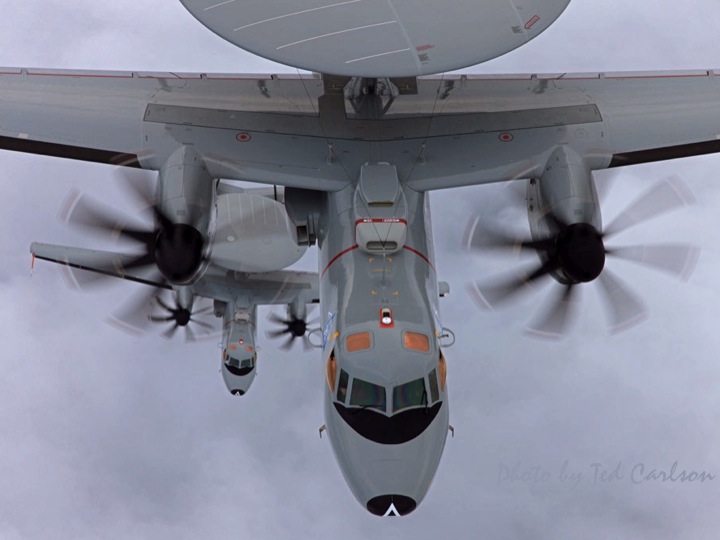
VAW-120 Receives First Fleet E-2D Advanced Hawkeye
NORFOLK, Va. (NNS) — The E-2D Advanced Hawkeye, the Navy’s newest airborne early warning and control aircraft, was delivered to the fleet July 29 at Naval Station Norfolk. Adm. Gary Roughead, chief of naval operations, accepted the Hawkeye on behalf of the Navy during a ceremony held on Chambers Field.
In a ceremony held at Norfolk Naval Air Station in Norfolk, VA, Northrop Grumman and the U.S. Navy celebrated the delivery of the first E-2D Advanced Hawkeye to the U.S. Navy fleet. Shown left to right are: Gary Ervin, president of Northrop Grumman Aerospace Systems Sector; Admiral Gary Roughead, Chief of Naval Operations, U.S. Navy; Vice Admiral Allen Myers, Commander, Naval Air Forces, U.S. Navy; Captain David Buttram, Commander, Airborne Command Control and Logistics Wing.
“It’s going to be a game changer with information dominance for the U.S. Navy,” Roughead said.
The Advanced Hawkeye, while not significantly changing the mission of early warning and control, will enable the aircraft to perform its mission with greater improvements. The new aircraft will be able to scan a larger area, detect smaller objects, process information faster. The aircrews will be able to accomplish these tasks through improved all glass cockpits and tactical operators stations
“While the Advanced Hawkeye may look familiar, on the inside it is a totally new aircraft,” said Gary Ervin, president of Northrop Grumman’s Aerospace Systems Sector. “The systems represent a multi-generational leap in technology.”
The advanced Hawkeye will go to Airborne Early Warning Squadron (VAW) 120, the “Greyhawks,” first. They are the Navy’s Fleet Replacement Squadron and will train pilots and Navy flight officers to fly and operate the new systems before assignment to an operational fleet squadron.
“Now it is up to Cmdr. Watkins and the 700 professionals of VAW 120 to push this aircraft to the limit and unlock its great potential,” said Ervin. “The work they do will set up for a seamless transition to the fleet.”
Like its predecessors, the E-2D is designed to last for many decades. Space has been left for advancement as new technology emerges.
“For longer than I have been in the Navy, the fleet has relied on the Hawkeye,” said Vice Adm. Allen Myers, commander Naval Air Forces Pacific. “It’s the first to launch and the last to recover on the flight deck, and has earned the reputation as the ears and eyes of the fleet.” (Source: Navy.mil)
Construction for the Next-Generation Aircraft Carrier, Gerald R. Ford (CVN 78) Reaches 11%
NEWPORT NEWS, Va., July 29, 2010 (GLOBE NEWSWIRE) — Northrop Grumman Corporation lifted two generators weighing over 195,000 pounds each into the aft section of the nuclear-powered aircraft carrier Gerald R. Ford (CVN 78), currently under construction at the company’s Shipbuilding sector in Newport News, Va., yesterday.
The diesel generators supply backup power throughout the ship in the event that power is lost.
“Landing these diesel generators is a significant event for us and is just one example of the many major components the yard is receiving and installing in the ship,” said Mike Shawcross, vice president of Newport News’ Aircraft Carrier Construction program. “Ford is now about 11 percent complete. We continue to be committed to executing each phase of construction with a focus on first-time quality. We’re excited with our progress and construction of the ship.”
Named after the 38th president of the United States, Gerald R. Ford (CVN 78), whose keel was laid Nov. 14, 2009, is the first ship of the new Gerald R. Ford class. The Ford class will continue the legacy of highly capable U.S. Navy nuclear-powered aircraft carrier ship platforms. Enhancements incorporated into the design include flight deck changes, improved weapons handling systems and a redesigned island, all resulting in increased aircraft sortie generation rates. It will also include new nuclear power plants; increased electrical power generation capacity; allowance for future technologies; and reduced workload for the sailors, translating to a smaller crew size and reduced operating costs for the Navy. (Source: Northrop Grumman)
F-35C Passes Drop Tests
FORT WORTH, Texas, June 23rd, 2010 — A Lockheed Martin F-35C Lightning II carrier variant successfully completed testing in which it was dropped from heights of more than 11 feet during a series of simulated aircraft-carrier landings. The tests validated predictions and will help confirm the F-35C’s structural integrity for carrier operations.
The jet, a ground-test article known as CG-1, underwent drop testing at Vought Aircraft Industries in Grand Prairie, Texas. No load exceedances or structural issues were found at any of the drop conditions, and all drops were conducted at the maximum carrier landing weight. The drop conditions included sink rates, or rates of descent, up to the maximum design value of 26.4 feet per second, as well as various angles and weight distributions. The tests were used to mimic the wide range of landing conditions expected in the fleet.
This final drop test follows the recent first flight of the first F-35C. (Source: Lockheed Martin)
A quick look at the sidebar will reveal a variety and number of books read over the course of the past year, oft times engendering discussions off-site as to selections and purpose. Looking at the current working stack on my desk, I thought I’d take this opportunity to talk to why these particular selections.  Understanding…
SJS, So two carriers or one? I can’t say, don’t know, and even if I did can’t talk about it. That being said, the media and some of their retired talking heads are playing up something out of nothing. We traded off with our relief and am now out in the IO cruising around Gonzo…
In this age of (near) instantaneous contact via email or, where accessible, the various pieces of social media our deployed Sailors, Marines, Soldiers and Airmen can access, there is still nothing, and I do mean nothing, quite as satisfying as a letter or package that arrives in the mail. The whiff of perfume still tenuously…
It is a meeting place where renowned scholars and self-taught history buffs linger and share ideas and perspective on naval events that shape nations. The Naval Institute and Naval History and Heritage Command have combined efforts to bring forth a new blog serving those with an interest in naval history. The christening page is up…
Today’s post comes by way of AT1 Charles Berlemann, Jr. Currently assigned to VAQ-135 (World Famous Back Ravens), he enlisted in 1998 and has made five deployments (see “Postcards from Deployment”). Interested since 1995 (Charles calls himself an “unofficial member), he joined the Institute in 1999. We have maintained correspondence for a few years now…
Announced today — story follows. While YHS wishes the name had been reserved for use on another class as part of a return to tradition and convention, one hopes CVN 79 will be Enterprise, America, Intrepid or Coral Sea. (ed. note: The model unveiled at yesterday’s announcement also showed a more, *ahem* complete airwing than…
 VAW-120 Receives First Fleet E-2D Advanced Hawkeye

The diesel generators supply backup power throughout the ship in the event that power is lost.


FORT WORTH, Texas, June 23rd, 2010 — A Lockheed Martin F-35C Lightning II carrier variant successfully completed testing in which it was dropped from heights of more than 11 feet during a series of simulated aircraft-carrier landings. The tests validated predictions and will help confirm the F-35C’s structural integrity for carrier operations.


One Comment
Comments are closed.