
КраÑÐ½Ð°Ñ Ð—Ð²ÐµÐ·Ð´Ð° Среда: Russian Missile News
Though it isn’t Thursday when we normally endeavor to post these updates (so sue us – ed.) it would appear that while we in the West are enjoying a typical holiday lull, those elsewhere, and in particular, in Russia are doing anything but.
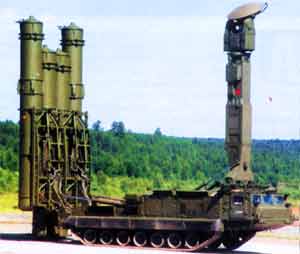
Item: Iran says Russia to supply new air defence system. TEHRAN (AFP) — Iran announced on Wednesday it is to receive S-300 air missile defence systems from Russia, a move that risks angering the United States which has been critical of past arms sales to Tehran. Iranian state media touted the S-300 as an even more sophisticated system than the TOR-M1, saying it could hit incoming enemy targets at a greater altitude. Iran said in January it had successfully test fired the TOR-M1. The United States had urged Russia to cancel that sale, saying it was a mistake when the UN Security Council had imposed sanctions on Iran’s ballistic missile industry as part of measures against its nuclear drive.
According to FAS’ site, the S300PMU1 is an extended range version of S-300PMU with a limited anti-ballistic missile capability, including capabilities against aerodynamic targets with speeds up to 3 kilometers/second. More problematic would have been sale of the S-300PMU2 Favorit which, according to the site:
(I)s a new missile with larger warhead and better guidance with a range of 200 km, versus the 150 km of previous versions. Unveiled at the MAKS’97 exhibition in August 1997, it represents a thorough modification of the S-300PMU1. The first tests were performed on 10 August 1995 at the Kapustin Yar firing range. One new element is the entirely new 96L6E autonomous mobile radar, which works in conjunction with the 83M6E2 control post and S-300MPU2 launchers. The new 48N6E2 missile, developed by MKB Fakel, weighs 1,800 kg, and is 7.5 m long and 0.5 m in diameter. After a cold start in the upright position with help of a catapult, the 48N6E2 accelerates up to 1,900 m/s in 12 sec time, and then approaches the target from above. The 48N6E2 differs from the older 48N6E in having a new warhead specially designed for destroying ballistic missiles, with a warhead weight of 145 kg versus 70-100 kg.
The S-300PMU2 Favorit can engage targets flying from 10 m to 27 km above the surface at a speed of up to 10,000 km/h. It is claimed that it has a kill ratio ranging from 0.8 to 0.93 against aircraft and from 0.8 to 0.98 against Tomahawk-class cruise missiles. (emphasis added)

The Russians have been busy this month on the domestic ballistic missile front as well, with two launches of the SS-N-23, one earlier this month and the second just the other day, both claimed to be successful (unlike the star-crossed Bulava-30) and a successful test of the RS-24 on Christmas Day. Recall that the SS-N-23 is a three-stage, liquid-fueled SLBM and the last SLBM of successful note manufactuered and deployed by Russia. It’s presumed replacement, the Bulava-30 – a solid-fueled missile sharing components with the successful land-mobile Topol-M has been anything but successful with failures in 5 of the last 7 test launches. Nevertheless, serial production of the Bulava was ordered earlier thi year and despite the most recent failure, it was announced this month that the next generation of sub would be deployed in 2008 fitted out with the Bulava:
MOSCOW. Dec 22 (Interfax-AVN) – Russia will put its strategic nuclear submarine Yury Dolgoruky, fitted with the new Bulava missile system, in service in 2008, the chief of armaments said on Saturday. "Of course, we’ll absolutely get it in 2008," Gen. of the Army Nikolai Makarov, who is also a deputy defense minister, told reporters.
Something tells us they’ll definitely be "getting it" in 2008, but that the "it" may not be the "it" they were counting on…
Finally, one area where there seems to be little question of success/capabilty is that of land-mobile ICBMs, the latest of which appears to be the RS-24 (MIRV’d Topol-M) which scored its latest successful launch the other day.
Tsar Vladimir hailed the launches as "beautiful holiday fireworks behind which was big work by military experts and civilian engineers. … Please congratulate them all, it was a serious step in strengthening Russia’s defense capability," Putin told Defense Minister Serdyukov in televised remarks.
So…here I is thinking that a 4 shot TEL, with a .8 to .98 Pk against T-Hawk is…well…bad.
But…let’s say I had a DDG with maybe only 10 TLAMs loaded just off the coast, and maybe a fellow DDG and atwo CGs in the battle group not too much farther to sea. Assume similar loads. Maybe it’s not so bad, if the reload speed of the TEL is a little more than say…oh, 5 minutes….
Can you say “saturating your defensive capability?” three times real fast?
They’ll have to have a lot of them and all somewhere on a threat axis. What kind of capability against an “off axis” shot, one not done “down the throat” for test numbers for foreign sales?
Remember that .8 – .98 Pk is for the S-300PMU2 and would presumably be under the direction of Voyska PVO (ВойÑка ПВО) or PLA personnel – under IIRG if (big if) they were to get it? Eh, maybe not so. Given the older technology of the S-300PMU1, I’d look for something a little less than the .8-.98 Pk against a TLAM strike, especially one that had any kind of dedicated ECM support…
– SJS
Still bad news though. not indefensible, some critical nodes in the system, but still, not good. When I was with VQ-6 (ES-3As), it was not nice being lit up by the SA-5s. having something newer, more efficient, more difficult to deafeat (especially the missile) not too nice. Agree with both statements, re overwhelming (burnthrough) their defenses, a new SSGN could definitely do it, easily. Expensive. We’ll just have to find their K-9 vulnerabilities. Also the Pk is VERY dependent on the operator. refer back to SPEAR threat equation. My concern is on the pucker factor of basically all the gulf and parts of adjacent land being under the umbrella of a fast, good double digit missile.
Claudio
SJS, as we know, the Russians are not above having “advisors” maintain/operate equipment sold to others either by their own (military) or “contractors”.
Claudio – all too true re. the “advisors” I’m afraid to say…
– SJS